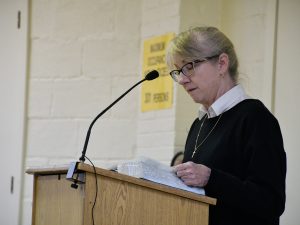
St. Mark’s is changing the way we present our Sunday morning worship service videos on YouTube in preparation for the day we reopen the building.
As the world slowly gets back to normal, discussions are underway about the best time and manner in which to reopen our building and worship together, in person. Once we reopen, our Sunday morning services will be streamed live. To prepare us all for that (hopefully imminent) time, we’re changing the way in which the prerecorded service videos will become available on Sunday mornings.
Rather than simply appearing, as they have been, each video will now “premiere” at 10 a.m. on Sunday. A notice of the premiere will appear on our YouTube channel sometime on Saturday evening and our YouTube subscribers should receive a notification at that time, too. Clicking on the link will take you to a “waiting room” where a countdown will indicate how much time remains before the video goes live.
To ensure everyone can find the video link in time for the start of the premiere, it will also appear on the St. Mark’s website in advance and the link will arrive by email, too. These links will also direct to the “waiting room,” and at 10 a.m. the video will begin playing automatically, synchronized on all screens and/or devices on which it appears at that time.
Once the video has premiered, it will be archived so that anyone who is unable to watch during the 10 a.m. premiere may view it later. During the premiere hour, those who tune in late can also rewind to the beginning and catch up on anything they missed.
In this way, we can all worship together at the same time, though still separate in location, and it will help us all to re-form the habit of worshiping at a set time on Sunday mornings.
A Prayer Guide for St. Mark’s Pentecost Prayer Vigil
Prepared by Clifford Smith
VENI SANCTE SPIRITUS
“Unless I go the Advocate [the Spirit] will not come to you; but if I do go, I will send him to you. He will lead you to the complete truth.” – John 16:7, 13
With these words Jesus points forward to the new life in the Spirit that will be revealed at Pentecost. It will be a life lived in “complete truth.” Closely related to the word “betrothal,” the “complete truth” means full intimacy with God, a betrothal in which the complete divine life is given to us.
“When the day of Pentecost had come, they were all together in one place. And suddenly from heaven there came a sound like the rush of a violent wind, and it filled the entire house where they were sitting.
“Divided tongues, as of fire, appeared among them, and a tongue rested on each of them. They were all filled with the Holy Spirit and began to speak different languages as the Spirit gave them power to express themselves….
“Now all who heard and saw these things were cut to the heart and said to Peter and to the other apostles, “Brothers, what should we do?” Peter said to them, “Repent, and be baptized every one of you in the name of Jesus Christ so that your sins may be forgiven; and you will receive the gift of the Holy Spirit. For the promise is for you, for your children, and for all who are far away, everyone whom the Lord our God calls to him.” . . . So those who welcomed his message were baptized, and that day about three thousand persons were added. They devoted themselves to the apostles’ teaching and fellowship, to the breaking of bread and the prayers.” — Acts 2:1-4, 37-40, 41-42.
THE SPIRIT ACTUALIZES OUR FAITH
We are waiting for the Spirit to come. Are we really? This morning during the Eucharist I spoke a little about preparing ourselves for Pentecost just as we prepare ourselves for Christmas and Easter. Still, for most of us, Pentecost is a nonevent. While on secular calendars Christmas and Easter are still marked, Pentecost is spectacularly absent.
But Pentecost is the coming of the Spirit of Jesus into the world. It is the celebration of God breaking through the boundaries of time and space and opening the whole world for the re-creating power of love. Pentecost is freedom, the power of the Spirit to blow where it wants.
Without Pentecost the Christ-event—the life, death, and resurrection of Jesus—remains imprisoned in history as something to remember, think about, and reflect on. The Spirit of Jesus comes to dwell within us, so that we can become living Christshere and now.
Pentecost lifts the whole mystery of salvation out of its particularities and makes it into something universal, embracing all peoples, all countries, all seasons, and all eras. Pentecost is also the moment of empowering. Each individual human being can claim the Spirit of Jesus as the guiding spirit of his or her life. In that Spirit we can speak and act freely and confidently with the knowledge that the same Spirit that inspired Jesus is inspiring us.
We certainly have to prepare ourselves carefully for this day of Pentecost so that we can not only receive fully the gifts of the Spirit but also let the Spirit bear fruit within us.
Henri Nouwen, adapted from: Jesus: A Gospel
It is the eve of Pentecost, the celebration of the coming of the promised Spirit. It is the vigil of the day that commemorates the beginning of the Church as bearer of the divine breath…. Pentecost is a moment of great prophetic significance. It marks the beginning of the Church and, therefore, is now the celebration of the Church’s birthday. Pentecost affirms that the Church is an enspirited continuance of the prophetic mission and power of Jesus the Christ.
The Church today continues to witness to the movement of the Spirit in the world, the Spirit which groans in us as it responds to the misery, the hatred, the hunger, and despair that burdens humankind. Centuries ago Paul wrote to the church in Rome about the groaning and indwelling of this Spirit. His words still ring true for us today:
“We know that the whole creation has been groaning in travail together until now; and not only the creation, but we ourselves, who have the first fruits of the Spirit, groan inwardly as we wait for adoption as children, the redemption of our bodies. For in this hope we were saved. Now hope that is seen is not hope. For who hopes for what they see? But if we hope for what we do not see, we wait for it with patience.
“Likewise, the Spirit helps us in our weakness; for we do not know how to pray as we ought, but God’s own Spirit intercedes for us with sighs too deep for words. And God who searches the hearts of all knows what is the mind of the Spirit, because the Spirit intercedes for the saints according to the will of God.” — Romans 8: 22-27.
Pentecost celebrates the indwelling of God’s hope in us, incarnate in our world through our lives.
Wendy M. Wright, adapted from The Rising
Who could turn a band of frightened fisherman into powerful preachers?
The Holy Spirit!
Who could begin the day with 120 believers, including the twelve disciples
and Jesus’ Mother, and end the day with more than 3,000?
The Holy Spirit!
And who empowers believers today, adding to their number and
challenging them to be a part of the Church He is building?
The Holy Spirit!
VENI SANCTE SPIRITUS
FOR REFLECTION AND PRAYER
1. How have you experienced the Holy Spirit in your life as Advocate or Helper? as Comforter? as Consoler? as Guide? as empowering?
2. Does it make any difference in your life —
To consciously regard yourself as the Body of Christ, that is, a member of the “body of believers,” the community of faith, the Church?
To know that the Spirit of Christ seeks to indwell in your heart, so that God’s hope and love can incarnate in today’s world through your presence and actions, through your life?
To know that you carry the “indwelling Spirit,” to know that you are a manifestation of the continuing incarnation?
3. What specific miseries and burdens of humankind cause you to “groan in travail with the whole of creation?” Pray that the Spirit assist you in prayer regarding these heartfelt “miseries and burdens.” Remember: “God’s own Spirit intercedes for us with sighs too deep for words.”
4. Offer your personalized and specific prayers for the well-being and fruitful action of today’s Church.
5. Where and how have you experienced the enlivening and empowering action of the Holy Spirit in the history and ministry of St. Mark’s?
Does it make any difference to know that the same Spirit that inspired and empowered the apostles on the day of Pentecost is today inspiring us at St. Mark’s and all of the Church?
I’ve been listening to music over the past few months while stuck in the house. I always feel better when I listen to songs I love and I tend to get them stuck in my head. YouTube is nice, it’s free and a bit of a time waster. Perfect.
I started with Bonnie Raitt singing “Angel from Montgomery,” but then John Prine died of COVID-19 and I was bummed. The world lost a beautiful writer. I don’t care how old he was.
The April “Lion” arrived and after reading Rev Mueller’s Musings I had Crosby, Stills, Nash and Young wailing “Ohio” for days. The distrust resonated with me.
Bob Marley and the Wailers’ “Exodus” came next. Not exactly Lutheran theology, but I like being one of Jah people — even if just for a few minutes.
And now — Alabama Shakes. “Hold On.” I can’t get it out of my head. If you haven’t heard it (and you like loud, rock, Janis Joplin-type music) find it on YouTube. It’s addictive. Brittany Howard mentions somebody up above a few times in the lyrics so God’s in there too. At least I believe he is. It’s my kind of prayer — especially when she wails “I don’t wanna wait.” It feels like a cry from one of the Psalms.
St Mark’s Council met on May 17. It was a long meeting — three hours. We had a lot to discuss. Fortunately, before I wrote this letter, the Governor sent guidelines for opening churches. And then we heard from the ELCA and then the Synod. We are getting a lot of advice. But, to be clear, no one is sure. We have a lot of information and common sense to sift through. Members of the congregation have had some great ideas too.
And now we have to buy stuff that may take awhile to get here. We need to be clean and safe. We are still working on a tentative date and we’ll get those specifics out when we have them. We have to be safe. But I want you to know we are working on a plan.
Council formed a Building Safety Committee to come up with suggestions for opening the building for a service. The Worship and Music Committee is working on how to have a safe service. We may not know exactly when we will be together but we will do our best to be safe. Council will meet again on May 31 via Zoom for more discussion.
A few other things:
We applied and were approved for a PPP (Paycheck Protection Program) loan. The money has been deposited in our account.
The Great Room is finished – waiting for us to return.
We have changed the locks on the outside doors. Inside door locks remain the same. We are going to be careful about distributing keys. There were way too many keys out there and this was a good time to get that under control. Let me know if you need to get in the church and I will arrange for you to get in. Council will decide on May 31 how many and who to give keys to. The church building remains closed at least through May 31.
A discussion group exploring the thoughts of modern-day theologians has been meeting since November 12. With from 10 to 14 attending participants, we have had thoughtful, lively, interactive discussions of the books “Unbelievable,” by John Shelby Spong, “Convictions: How I Learned What Matters Most,” by Marcus J. Borg, and nine articles on “The Future of Christianity” by various authors from the journal Oneing, from Richard Rohr’s Center for Action and Contemplation.
Now we are ready to consider and discuss a new book: “Red Letter Revolution: What If Jesus Really Meant What He Said?” by best-selling authors Shane Claiborne and Tony Campolo. This is the perfect time for any interested new participants to join the MDT Discussion Group. We are now meeting by means of Zoom and the next meeting will be 10:30 a.m. to noon on Saturday, May 23.If you wish to join us, send your email address to Clifford Smith (whose contact information may be obtained from the church office at (302) 764-7488 or office@stmarksonline.org) and your name will be added to the email membership list. You will then receive all emails regarding the meetings of the MDT Discussion Group, including a Zoom invitation for the May 23rd meeting and all subsequent meetings.
We are a participatory discussion group, more like a book club than an Adult Education Class, guided by the assumption that each person is the “expert” for his/her own responses and expressions of thoughts, emotions, and opinions. We make use of a changing designated facilitator whose task is to keep the group on track but not to be the teacher. Lynne and Greg Landrey will facilitate the discussion of “Red Letter Revolution” for the meeting on May 23. We will discuss “Part I: Red Letter Theology” (pages 3-73).
If you are at all interested, feel welcome to join us and check us out on May 23 or any time thereafter.
As we continue to observe social distance to help slow the spread of the Coronavirus, we give thanks for the technology and leaders that bring us together even when we are apart.
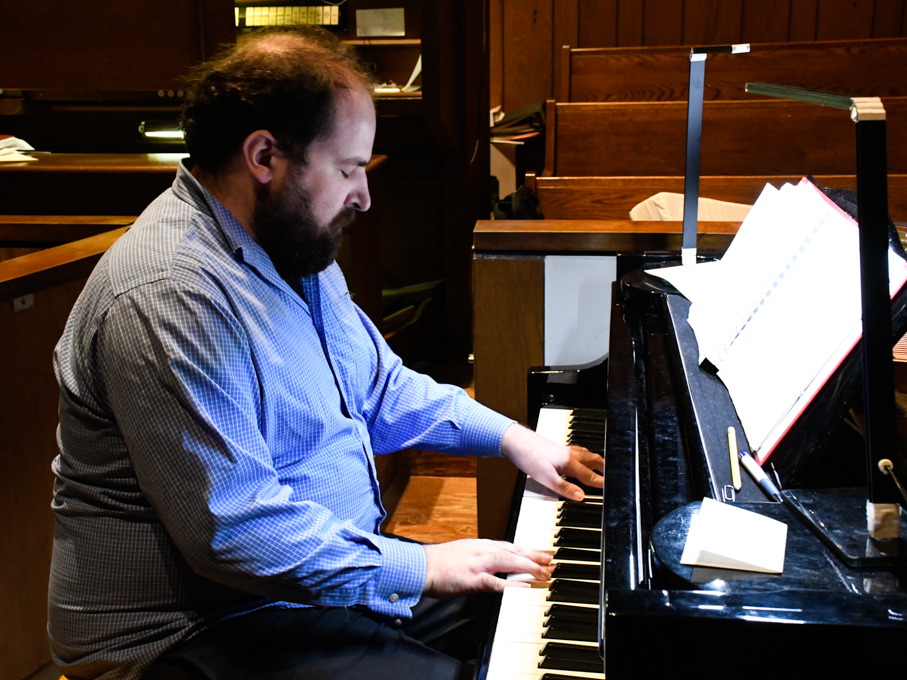
Join us for this pre-recorded worship service, led by Interim Pastor David E. Mueller, Director of Music and Worship Arts John Lasher and Worship Assistant Gregory Landrey. Also participating are this week’s virtual choir: Dave Herrmann, John Lasher, David McClure, John Nichols and Cheryl Powell and vocalists Fred Meckley, Jan Meckley and Teresa Stebner.
The link to the video is below and you can follow along with the text of Pastor’s sermon here, too.
“Abiding ‘Effectionately’” (John 14:15-21)
David E. Mueller, Interim Pastor
I believe I have previously shared with the people of St. Mark’s about the “Get Well” card we developed at Concordia a long time ago. It bears repeating today. You will see why in a minute.
In my pastoral training, we were taught when entering a hospital room or a living room to take a quick snapshot. In the case of a hospital room, look for cards, flowers, balloons or any other signs that the patient has people who care for her or him. Living rooms are far more difficult to assess.
In hospital rooms, I often noticed a card signed by everyone back at the fire hall, the Kiwanis, or the bowling league. I wondered why we couldn’t design a card from the congregation. A commercial artist in the congregation and I put our heads together and came up with a functional design. A scroll-like oval formed the outer side of an 8 X10 piece of heavy and nice stationary forming the words: “Your brothers and sisters in Christ at Concordia are praying for you.” We passed this around during worship on a clipboard and everyone in attendance signed it. It turned out to be wildly popular both for those who received it as well as a reminder to pray for those who signed it. It folded with praying hands on the cover and a Bible verse on the right inside folded page. The verse was John 14:18, which read in the then RSV: “I will not leave you desolate; I will come to you.”
Especially during times of spiritual struggle, medical malady, relational brokenness, pandemics and whatever else might be causing a person agony, promises of God become particularly pertinent. The only caveat that invariably must be understood and accepted is God’s timetable.
I have often used the illustration of a toothache, which thank heavens I have not had in a long time. When a severe toothache hits, the whole body becomes almost useless and whatever one is doing or supposed to do comes to a grinding halt until one’s dentist can work her miraculous art. For some period of time we are defined by that toothache. No amount of time spent remembering that your kidneys and other vital organs are functioning fine matters.
In many human circumstances with pain, a person in effect can to some extent be defined by the matter. He becomes a “cancer patient;” she is a “divorcee and single mother;” Mabel has a son who is a “junkie.” The prayers for remedy can be prayed without ceasing even as the tears are increasing and the fears not decreasing. God seems a million miles away, not really giving a rip about my issue, or too busy with more difficult problems, etc. The “I will come to you” promise seems shallow and extremely difficult to believe.
I have been touched in my own struggles with Psalm 6. It’s a short Psalm and I hope you will read it later. In it, David is desperate and depressed. He floods his bed with tears. Nothing is going right. But in short order, long before any actual resolution to his issues, David reaches out and proclaims: “The Lord has heard my supplications; the Lord accepts my prayer. All my enemies SHALL be ashamed….” (6: 9 & 10a) In effect, David seems to have learned to trust God’s timing.
Jesus promised to return and it has been two millennia! God is not in a hurry!
“How long, O Lord? Will you forget me forever? How long will you hide your face from me? How long must I bear pain in my soul and have sorrow in my heart all day long?” (Psalm 13:1-2a;). Here too, David holds nothing back in his questioning, but we need jump only a few verses (5 & 6) to read: “But I trusted in your steadfast love; my heart shall rejoice in your salvation. I will sing to the Lord, because he has dealt bountifully with me.”
There is a spiritual art to maintaining faith in the midst of difficulty, disaster, dismay. In John’s Gospel, appointed for today, there are some “holy hints.”
“If you love me you will keep my commandments.” Dutch Priest Henri Nouwen has written about “the wounded healer.” Often, those most effective in helping — even healing — others, are those who are themselves in pain. Sensitivity activates in us that often isn’t present or active when all is well. The current viral crisis has produced incredible amounts and accounts of people helping people even if there are also sad accounts of others being self- absorbed and unreasonable.
Years ago, I was attending another conference and was in great emotional pain. I ended up co-founding a professional organization and the letters I received when I got back astounded me. One Native American wrote: “Everything you said had deep top roots of wisdom.” That sounded and felt good but I didn’t understand how I could have functioned so well, given how I felt. Jesus’ primary commandment to “love one another,” did not abrogate loving God and others as self, but accentuated them. Loving may seem easier when all goes well, difficult but deeper when things are not right.
Jesus also offers the Holy Spirit, the “Advocate.” I love Acts 4:31: “When they (the Disciples) had prayed, the place in which they were gathered together was shaken, and they were all filled with the Holy Spirit and spoke the word of Godwith boldness.” The Holy Spirit empowers us to love.
“Because I live, you also will live.” (John 14: 19b) And that is our hope, no matter how dark the night, joy comes in the morning. (See Psalm 30:5.)
When it comes to God acting, God fulfilling promises, we need faith (trust), love, spiritual empowerment, hope, and … patience. James the Apostle in his letter (5:7) wrote: “Be patient, therefore, beloved, until the coming of the Lord.”
This litany of necessary ingredients to abiding “effectionately,” as well as affectionately, is no small list and of no minor tools of the truth trade. Yet as we receive and employ this equipment, these gifts: “You know him (Jesus), because he abides with you, and he will be in you.” Nothing that can be named (see Romans 8:31ff) can separate us from him, nothing! Jesus means everything! Amen.
As we continue to deal with the Coronavirus pandemic, we again have a pre-recorded worship service for Sunday, May 10. The link is below, along with the text of Interim Pastor David E. Mueller’s message.
Thanks to those who have assisted this week, including John Lasher, director of music and worship arts, Cheryl Powell, worship assistant, and this week’s virtual choir: Dave Herrmann, John Lasher, David McClure, John Nichols, Cheryl Powell and Teresa Stebner, along with vocalists Fred and Jan Meckley.
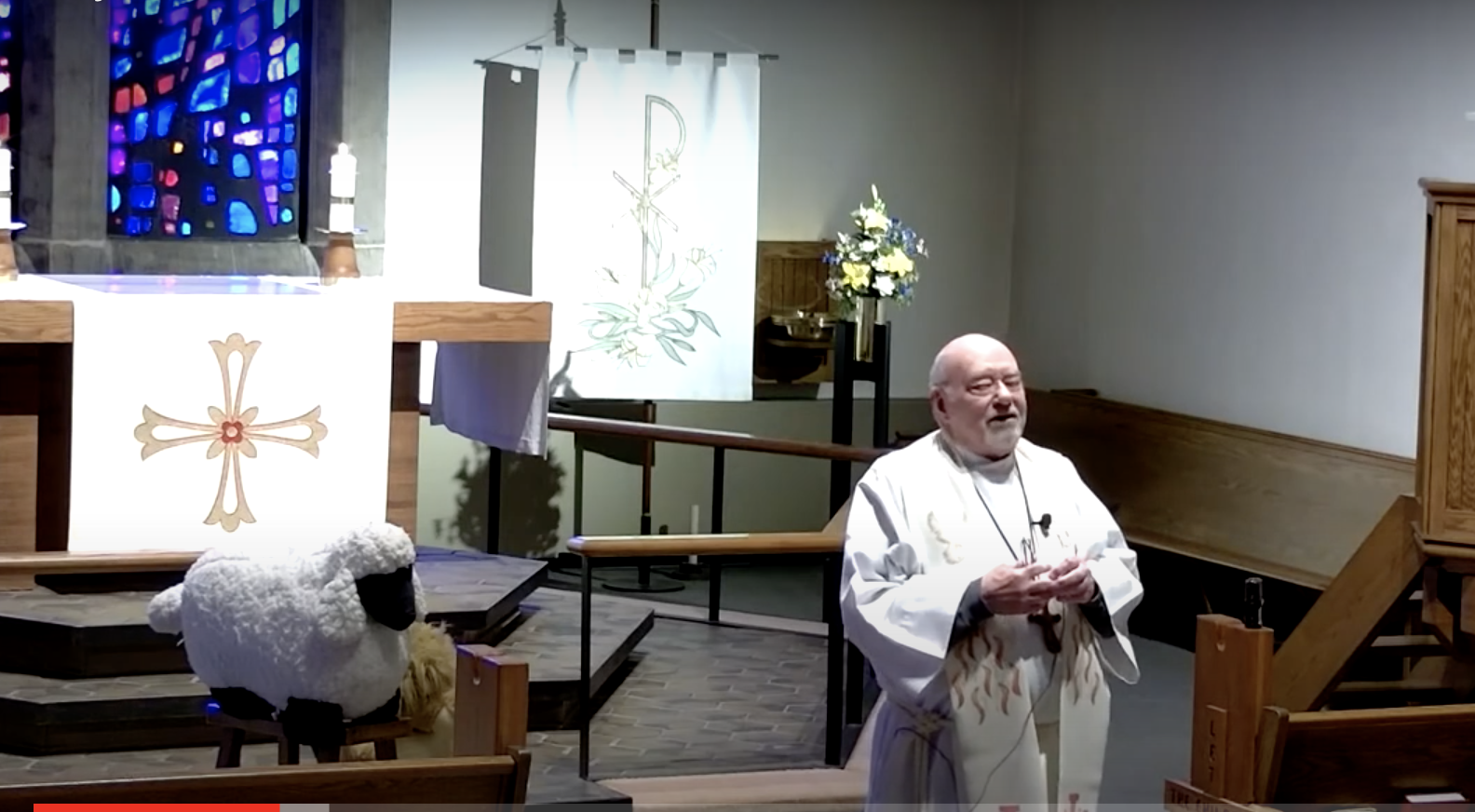
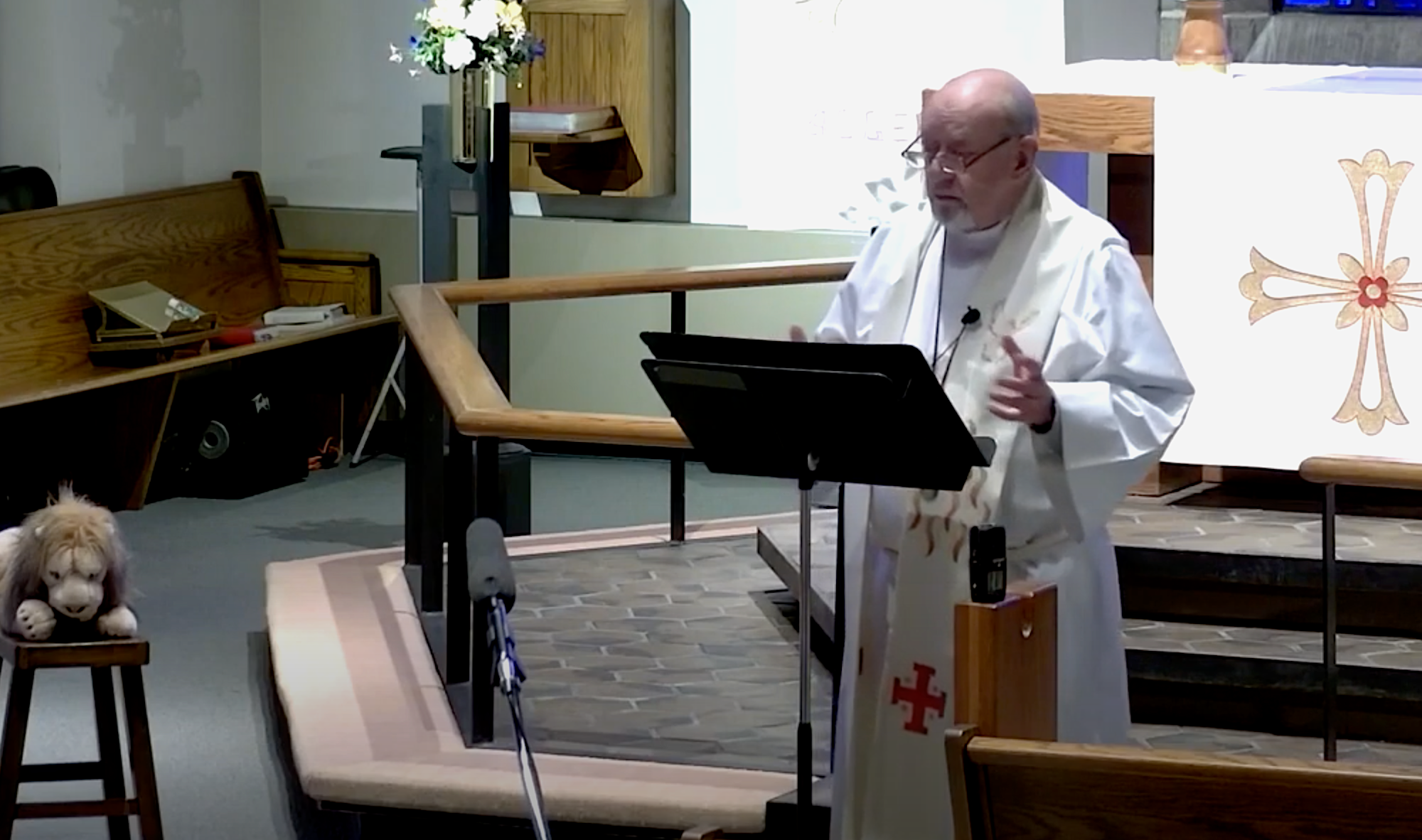
And don’t miss the continuing saga of Leroy the Lion and Larry the Lamb, today with a new friend: Lenny.
Here is today’s service:
“There Are a Few Troubling Matters Remaining”
John 14:1-14 & 1 Peter 2:9 & 10
Interim Pastor David E. Mueller
Our appointed Gospel lesson for today from John 14 is a favorite to many. The statement by Jesus “In my Father’s house there are many dwelling places,” is one of those holy hints about eternal glory. Jesus also said “I go to prepare aplace for you,” giving his promise a personal sense. We may have heard elements of this section of John at funerals previously. We need this sort of biblically grounded hope during difficult and dangerous times like right now.
A few weeks back I mentioned the familiar phrase: “I am the way, the truth, andthe life.” I attempted in a simple way to interpret the original Greek so as to give further understanding of “way, truth, and life.” Immediately following this “I am” of Jesus (there are seven of those “I ams” in John’s Gospel), we read: “Noone comes to the Father except through me!” I am not troubled by this last statement, but I am troubled in the extreme by how it is often interpreted, that is, to exclude others who may not believe in Jesus as we do.
The conversation happening here between Jesus and His disciples, two of whom are named (Thomas and Philip), is itself intimate and personal. Their hearts were troubled and in the face of their troubled hearts, Jesus draws them closer to himself. Jesus invites their belief in God and in him. He makes a clear association throughout this whole section of himself and the Father. “Believe me that I am in the Father and the Father is in me.” (14:11)
Precisely because of this eternal relationship of Jesus and the Father, Jesus makes promises, some extraordinary, that the disciples were to trust. If they had a problem with that or with the Father/Son relationship, Jesus simply invited them to review the “works” (miracles, healings, etc.) and conclude that no such things could possibly have happened were they not from God.
Earlier in his ministry, the disciples of John the Baptizer, came to Jesus on John’s behalf and asked, “Are you the one or should we look for another?” (See Matthew 11 & Luke 7) Jesus’ response was for them to look around to notice the blind seeing, the deaf hearing, the lame walking and the like. Look at the “works.” Notice well the product. Even the Pharisees on occasion acknowledged, if reluctantly, that only God could do that which Jesus did, especially in healing.
I operate with one fundamental assumption when it comes to reported miracles and healings of Jesus, namely, that I want and need a God who is bigger than me and larger and more powerful than any other force we might name. One might argue about a particular miracle or healing in the Christian scriptures, including those accomplished by various disciples AFTER Jesus had ascended, but what good does it do to argue the miraculous itself? Miracles — that is, events usually of a positive kind that defy science, reason and our limited imaginations — happen.
I have personally experienced several miracles. I am careful about sharing them and sensitive because I know of scores of human beings who have prayed and prayed for a healing of their own or a loved one’s illness or a miracle and it didn’t happen. I am no more worthy of God’s attention than any other human being. Many of you know however, that after five years apart, Gigi and I were remarried right here at St. Mark’s 35 years ago, a genuine miracle. Yet after even more prayer than ours, there are broken marriages that are never healed.
Here in our Gospel, Jesus assures the disciples that they have good reasons to not let their hearts be troubled any longer. In effect, “It will be OK as you trust me!”
The Gospel ends with what shouldn’t be but all too often is troubling. “Very truly,I tell you, the one who believes in me will also do the works that I do, and in fact, will do greater works than these….” (14:12) Who me? Who us? Yep! The troubling aspect: where is our faith, faith strong enough to move mountains? This seems to strongly suggest that in faith, since I believe in Jesus, I need to believe in myself, not my unredeemed mired-in-sin self, but my loved and redeemed self. We learn elsewhere in Scripture that when loved and redeemed selves get together forming a loved and redeemed Church, all sorts and kinds of great healing, miraculous and caring things can happen.
Turn with me to our second lesson from 1 Peter 2:9-10.
“But you are a chosen race, a royal priesthood, a holy nation, God’s own people in order that you may proclaim the mighty acts of him who called you out of darkness and into his marvelous light. Once you were not a people, but now you are God’s people; once you had not received mercy, but now you have receivedmercy.”
We are among those communities of believers in Christ, mercifully drawn to him in grace, and, as such, have a very special place in God’s heart. “I am the way, truth, and life. No one comes to the Father except through me.” (John 14:6) Remember that this was said in a personal and private context by Jesus toward His disciples, who were troubled in heart. Now, as a chosen, royal and holy people, how can we stand before others, any others, and treat them with anything less than dignity and love? I am not chosen to judge others, not royal to lord it over others, not holy to condemn others, but God’s people are to proclaim to others God’s grace, mercy, and steadfast love for them as well.
In my decades of attending national Jewish-Christian conferences, nothing has stood out to me more than a workshop on “Chosen-ness.” It had to be 30 years ago in that workshop that the Jewish and Christian attendees were told by a Rabbinical scholar that “we should never use our chosen-ness to denigrate anyone.” My chosen-ness allows me and enables me to be about those “even greater works.” Denigrating or judging others is not among the greater works.
More than ever, perhaps especially in our own USA, we need to be touching people as Christ touched people, heal as He healed, help as he helped, feed as he fed, forgive as he has forgiven us, love as he has loved us, lead as he has led us! I believe this a time when more than ever we must proclaim the mighty acts of God. Unfortunately there are all too many who are proclaiming the judgment, condemnation and wrath of God.
If God is, indeed, larger and mightier than us, then God can do the judging, but in the meantime, we are charged with doing the loving. After all “Faith, hope and love abide, but the greatest of these is love.” (1 Corinthians 13:13) It remains for us to understand, celebrate, and share the greater works. Oh, in case you are feeling inadequate about this, “If in my name you ask me for anything, I will do it!” Amen.
Please allow me a brief postscript. Today might be the fifth Sunday of the Easter Season, but it is also Mother’s Day and about that I would simply say: “As a mother comforts her child, so I will comfort you….” (Isaiah 66:13a) We have plenty of reasons for making a connection between good and loving parenting and a good and loving God! Enough said except again: Happy Mother’s Day!
[Editor’s note: We are thankful to The Rev. Gordon E. Simmons, interim pastor at St. Andrew’s Lutheran Church in Dover, for today’s message as we worship remotely during this Coronavirus pandemic. In addition to his pastoral duties, Pastor Simmons serves as director of the Lutheran Office for Public Policy in Delaware. Thanks, too, to John Lasher, our director of music and worship arts, for putting this service together. Among the participants this week: Interim Pastor David E. Mueller and Nancy Myers, worship assistant. Our musicians include soloist Paige Stebner and the virtual choir, which includes Dave Herrmann, John Lasher, David McClure, John Nichols, Cheryl Powell and Teresa Stebner. You will also hear Jan and Fred Meckley on “The Lord’s Prayer.”]
Join our pre-recorded worship here and follow the text of Pastor Simmons’ message below.
“The Good and Dirty Shepherd”
The Rev. Gordon E. Simmons
John 10:11-18
INTROThose of you who have been hearing me preach for a while know that sometimes I like to preach a little differently. It’s not always the same.
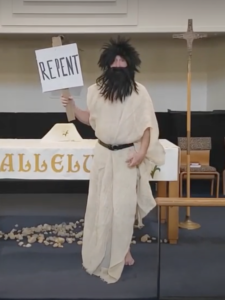
THE PREACHER AS JOHN THE BAPTISTOne week I preached like John the Baptist.
THE PREACHER AS BICYCLISTOne week I tried to illustrate the importance of daily prayer as a spiritual discipline by comparing it to getting dressed up in warm clothes to ride a bike in the winter.Daily prayer is for our protection. Just like warm clothes in the winter, daily prayer is something we really need.
THE PREACHER ON A LADDEROne week I preached my sermon from up on top of a ladder. It was the week when we had the story of Jesus going up on a mountain with a few of his disciples. I said that things look different when you are up on a mountain. We have our own mountaintop experiences when we come to worship.
Now today, we have our text from the 10th chapter of John, where Jesus says, “I am the Good Shepherd.”I was trying to think about what modern image we might have for a shepherd.There aren’t many shepherds around much anymore.Most of us aren’t really familiar with them.I’ve never seen a flock of sheep being herded down the street in front of my house.So I wondered: What’s a shepherd image in 2020?
THE PREACHER AS TRASH COLLECTORI thought about a trash collector. Someone who has to get down and dirty to do his job. I know, I know everyone has these sweet Biblical pictures of Jesus, the Good Shepherd, holding a cute little lamb. Jesus is always wearing a clean, pressed robe, and, of course, you would expect Jesus himself to be all cleaned up to have his picture taken.
But here’s the truth. Being a shepherd was a dirty job. How do you think you’d smell if you were sleeping with the sheep all the time? And if you’re following the sheep around every day, well, you’d better watch where you step. And your clothes? Hey, you’re living outside, in a desert. You think your clothes are going to stay clean when the wind is blowing the dirt and sand all over the place? When storms come up and you get soaked to the skin? I’m telling you, being a shepherd was a dirty job. Just like when you’re out picking up trash on the highway.
There are dangers for trash collectors. There are holes you can step in and rain-soaked grass you can slip on, and — I’ll tell you this from experience — most of the cars zipping along the road don’t pay much attention to you. You’re pretty vulnerable when you’re out picking up trash on the road.
Shepherds were vulnerable, too. There were wild animals out there who loved to get their teeth into one of your sheep. And if you’re a shepherd and you try to stand in the way, well, I guess the mountain lion or the wolf wouldn’t mind making a meal of you, too. You really think a shepherd’s staff is going to offer much protection against a wild animal who hasn’t eaten for a week?
So you can forget all these sweet little pictures of Jesus all dressed up as a cleaned-up, neat-looking shepherd. It was a dirty job. Somebody had to do it. I suppose that’s why John held up this story of Jesus as the Good Shepherd. Jesus was good because he saw the dirty work and he was willing to do it.
In the passage we have for today, from the 10th chapter of John, Jesus says that a shepherd has to be willing to lay down his life for his sheep. If you aren’t, the Gospel lesson says, then the wolf will come and snatch the sheep away.
Sometimes when I’m out picking up trash, a dog will come running out of his house, barking like crazy, chasing me away from his yard. And that’s just a dog. If somebody told me there were wolves out there, I think I’d stay home.
Jesus said, “The good shepherd lays down his life for his sheep.” I’m telling you, this shepherding thing in the first century was dirty work. Somebody, though, somebody had to do it.
Of course Jesus wasn’t really a shepherd, but he was someone who laid down his life, someone who laid down his life for the whole world.
You know, it’s only the fourth Sunday of Easter, and here we are, again, already back to the crucifixion. I thought this was supposed to be the happy time. What’s with this “lay down his life” theme coming back again?
One of the great things about the Christian faith is that the joy that we rightly announce, on Easter, and, all the time really, is not a cheap joy. Christians don’t say, “Oh, let’s just be happy and try to forget about all the terrible things going on in the world.” Christians don’t believe that when you become a Christian all your problems will go away, or that everything will always be pleasant. Christians aren’t always wearing smiley faces. Christians understand that there is still a lot of dirty work to be done and that somebody has to do it. But we’re not overwhelmed by this dirty work. We know the victory has been won. Easter songs are always in season. Jesus laid down his life for us so that we can give of ourselves for others.
Our first reading for today, from the book of Acts, gives us a little peek into what life was like for the very first Christians. It says they held all things in common. It says that they sold their possessions so they would have some liquid capital which they could then distribute to those in need. It says that they had glad and generous hearts.
When you read these verses, it makes being a Christian sound awfully sweet and pleasant. Wouldn’t it have been wonderful to be a part of such a loving, generous group? Ah, come on! Get real! Read between the lines! You think everybody was really happy about having to give up all their savings and all their property so that others would have enough? You think everybody who had a little extra was excited about giving it away? You think this was easy? No! It wasn’t easy. It was dirty work, but somebody had to do it. So the first Christians did. And many Christians have been doing it ever since.
It’s because we’re following the Good Shepherd, the one who was willing to, and who did, lay down his life for his sheep. We’re following the one who gave his life for us. And who won a victory while doing it.
So, as followers of Jesus, we’ve got some dirty work to do. And we’re out and about doing it. But it doesn’t overburden us, not really, not when we stop to think about it. This is still Easter! We have a lot to celebrate! So let the celebration begin.
THE PREACHER AS PARTY GOERIt’s time to party! This is still Easter! Come on now! It’s party time! Christ is risen! He is risen indeed!
By now, you probably know a lot about Zoom — the online video meeting platform that allows people to “meet” remotely by computer during these days of the COVID-19 pandemic. Maybe much of your work requires such meetings, maybe your family and friends are catching up that way or maybe you’ve just heard a lot of Zoom jokes.
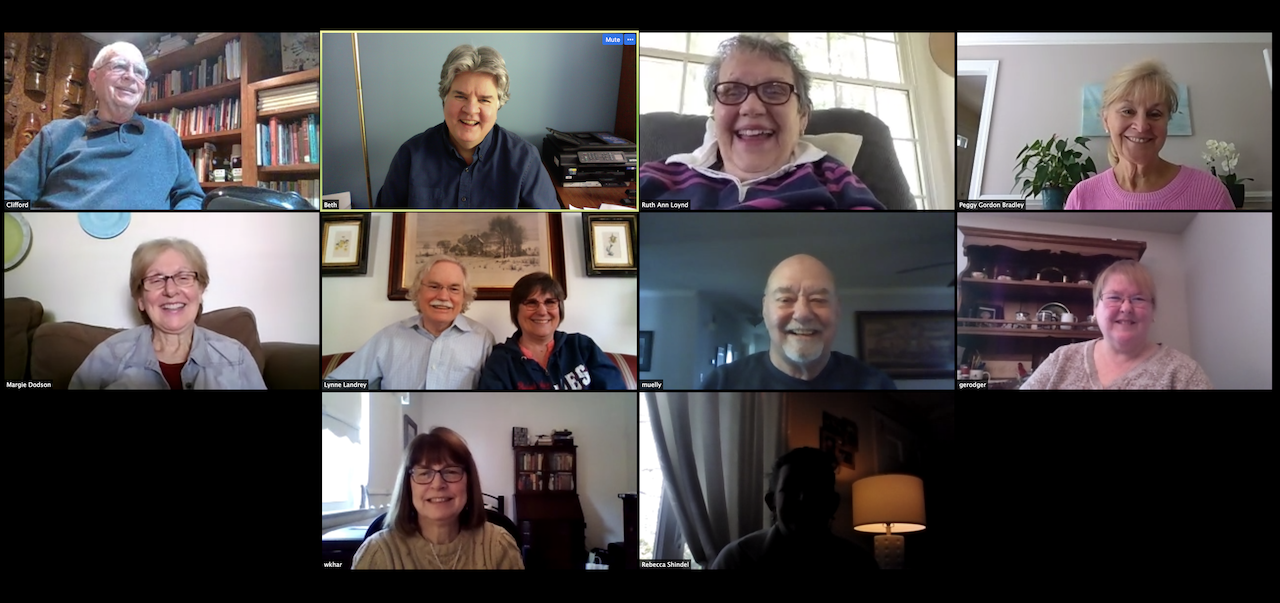
Some St. Mark’s members have been meeting by Zoom to carry on church business and to study. Among them are: the Leadership Council, the Transition Team, the Worship and Music Committee, the Wednesday Morning Bible Study and the Modern-Day Theologians group.
Now two new studies are forming — one studying Martin Luther, led by Gregory and Lynne Landrey, and one studying the seven churches of Asia Minor, led by Interim Pastor David Mueller. Details are below.
Both require a computer and Internet access. Both are limited to 20 participants. If you have not used Zoom before, we’ll help you get up to speed.
Registration information is listed below, depending on which class you wish to join. If you have any questions, call the church office at (302) 764-7488 or send an email to office@stmarksonline.org.
CLASS DETAILS
WEDNESDAY EVENINGS:
Martin Luther: The Idea That Changed The World
Video and discussion
On October 31, 1517, a young monk named Martin Luther nailed a list of 95 debate topics denouncing the corruption of the medieval world’s largest and most power institution to the doors of the Castle Church in Wittenberg, Germany. This act set into motion a series of events that would change the world in ways he could never have imagined.
The PBS documentary “Martin Luther: The Idea That Changed the World” was produced in 2017 to celebrate the 500thanniversary of this remarkable event.
During this six-session class, we will be viewing the movie in its entirety. Each session will consist of watching approximately 15 minutes of the movie, reviewing it, making scriptural connections and discussing how it applies to our lives today.
WHEN: 7 to 8:15 p.m., Wednesdays, from May 6 through June 10
NOTE: When signing up, please provide First/Last Name and email contact information. Also, kindly indicate if you are familiar with using the Zoom format or would like to participate in a brief tutorial.
SUNDAY MORNINGS:
The Seven Churches of Asia Minor
(Revelation 2 & 3)
The last book listed in the Christian “canon” has been the subject of abuse by some and neglect by most of us. “Apocalyptic” literature is utterly unfamiliar to us. Apocalyptic literature is characterized by the use of numbers and word pictures employed to assist in giving the best possible understanding of otherwise complex and seemingly cryptic matters.
Revelation can simply be viewed as a series of seven sevens. Do the math and one gets 49. The next number is 50, which in Biblical presentation is “Jubilee” or “The chance to start over again in a fresh manner.” This makes Revelation hopeful even if after some frightening images throughout.
The first “seven” has to do with the Seven Churches of Asia Minor. These are foundational to the rest of the book. Since seven means “complete,” this is a complete commentary by Christ of the Church, today as then.
WHEN: 9 to 10:15 a.m., Sundays, beginning May 10 through June 21
LEADER: Interim Pastor David E. Mueller
CLASS SIZE LIMIT: 20
FORMAT: Zoom. Written copies of each session will be provided via email, each Monday after the session.
Six words from the book of Esther I can’t get out of my head. As a country, as a church, as a congregation we have never seen anything like the time we are living. My emotions have been all over the place. Concern, worry, irritation and fear are just some of those. And yet, in the middle of all of it — always when least expected — a lot of good. For such a time as this. Our congregation amazes me as we continue to be there for each other.
St Mark’s Council met on Sunday April 19 — not the way we always have, in a room, facing each other — but in a new way, on the phone and on our computers. For such a time as this. I am grateful for technology. Technology has brought us connectivity and using it is keeping us together. Without skipping a beat our worship services continue — not the way we always have in the sanctuary, with each other, but in a new way – on the phone and on our computers. For some, in the mail. For such a time as this. I am grateful for our Interim Pastor and staff. I am grateful for our members and the use of the gifts we have been given. The gift of technology and knowledge and persistence and a willingness and desire to continue.
While most of us have been waiting and praying at home, for some in our church this has been a very busy time. Our Worship committee, Communication Team and Staff have worked many hours putting together worship services that seem almost effortless. For such a time as this.
Good News.
During this quiet time in our Church life members of our congregation have been busy painting the Great Room — floor to ceiling. The floors have been cleaned and waxed. A lot of hard work went in to that. I am grateful.
Over the past weeks, while we’ve been social distancing at home, our Mission Endowment Fund approved and funded purchasing equipment to record our weekly and Holy Week Services. Worship services were recorded, blended and edited. A lot of hard work. I am grateful.
Our website and specifically, the Worship service viewership has increased weekly. March 15, our first Sunday online, was visited 133 times. Easter Sunday, we had 437 visits. A lot of hard work. I am grateful.
Our Council and Transition Team continue to meet. Our staff continues to work. Our members are doing everything they can. Leadership is making difficult decisions. I encourage you to continue to reach out to one another. The church is the people – not the building. But you know that already. Speaking of the building – back to the practical. I strongly encourage you to continue giving financially to St Mark’s. Our bills still need to be paid. Giving is down.
St Mark’s is still here. Call the office or Pastor. Continue to pray. We will be together soon. For such a time as this.

 There are dangers for trash collectors. There are holes you can step in and rain-soaked grass you can slip on, and — I’ll tell you this from experience — most of the cars zipping along the road don’t pay much attention to you. You’re pretty vulnerable when you’re out picking up trash on the road.